
How We Rank MTG’s Most Popular Cards
- Dec 4, 2025
- 4 min read
A deeper look at how MTG Best Cards uncovers what the Magic community is really excited about.

Magic: The Gathering is a massive, ever-evolving game. Between the 26,000+ cards that currently exist, the constantly shifting formats, and the steady drumbeat of new sets every few months, the landscape never stays the same for long. With so many moving parts, it can be surprisingly difficult to answer what should be a simple question: which cards are the most popular right now?
At MTG Best Cards, we’ve created a ranking system specifically designed to cut through the noise. Instead of relying on a single source of data or focusing on one particular format, our approach blends multiple signals from across the wider Magic community. The result is a list that feels alive—capable of highlighting long-standing staples, but also quick to catch the cards that are suddenly everywhere thanks to a new commander, a freshly revealed combo, or a powerful reprint.
Below is a more detailed look at how our rankings work and why they offer such an accurate snapshot of what players are genuinely paying attention to.
1. We Track Real Player Interest — Not Just Gameplay Data
Our process begins with monitoring what real players are actually showing interest in. This includes the cards people are searching for online, the ones they’re reading about, the decks that are getting attention, and the hype that naturally builds around certain strategies.
By focusing on player behaviour rather than just raw gameplay, we can identify:
Cards that are suddenly generating buzz
Cards that remain popular month after month
Older cards that are unexpectedly resurging
This approach gives our rankings a level of immediacy that traditional play data can’t always capture. If players everywhere start talking about a card—even before it shows up in major decklists—we see that.

2. We Balance Long-Term Consistency With Short-Term Trends
Not all popularity is created equal. Some cards are beloved across formats and have decades-long reputations as pillars of the game. Others flare up for a short period due to hype from a new release, a viral deck tech, or a particularly appealing variant.
To reflect both, we calculate two separate signals:
A long-term popularity score that shows which cards remain consistently important
A short-term “trending” score that captures sudden spikes in attention
By including both of these in our final score, we can surface cards that command respect year after year and highlight cards that are exploding right now. The blend of long- and short-term views allows the rankings to tell a more complete and dynamic story.

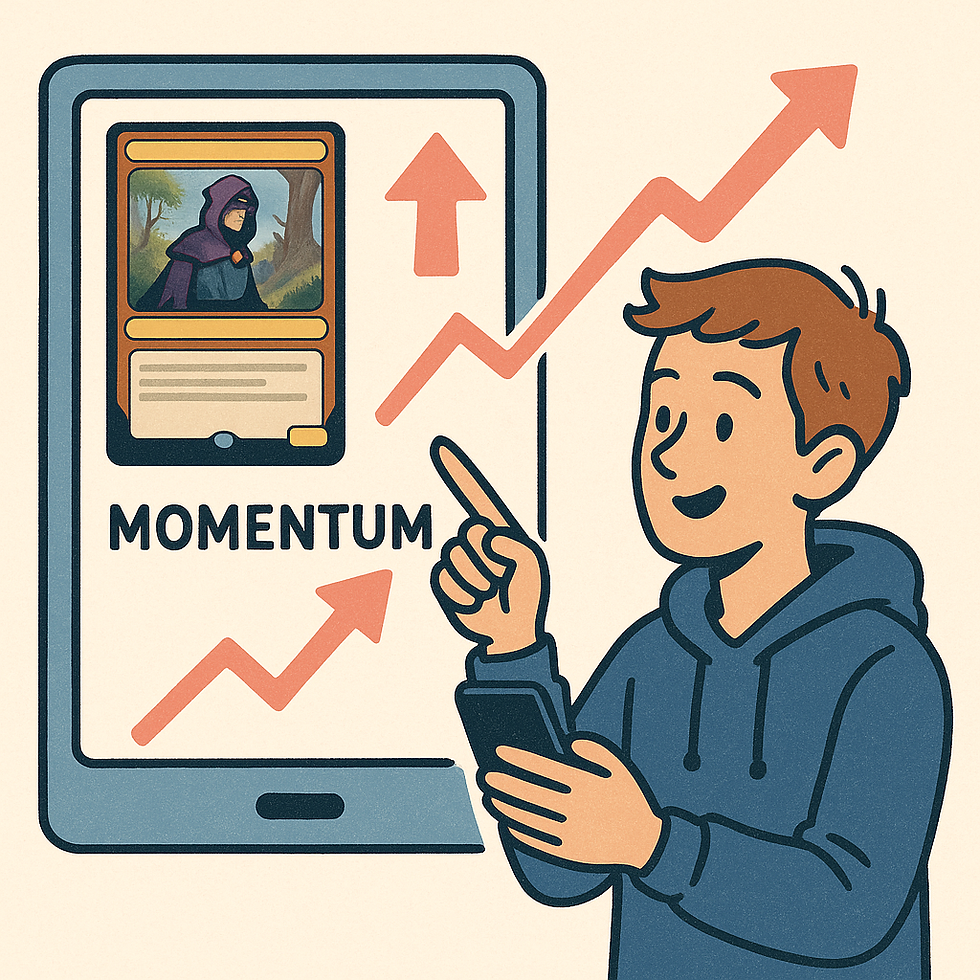
3. We Track a Card’s Momentum — How Fast Its Popularity Is Rising
Popularity isn’t just about where a card is today—it's also about where it’s heading. Magic players move quickly, and a card that barely made a ripple last month can suddenly explode in attention thanks to exposure on social media, a fresh combo, or an unexpected synergy found by the community.
To capture this energy, we calculate something we call momentum.
Momentum is our way of measuring the speed at which a card’s popularity is changing. Instead of only looking at raw numbers, we pay close attention to how sharply interest is rising (or falling). This helps us see:
Which cards are suddenly being talked about everywhere
Which new releases are gaining traction faster than expected
Which older cards are being rediscovered by the community
Which cards are coasting downward and losing steam
This momentum signal is especially important because it highlights cards that traditional data sources often miss. A card might not be a long-term staple yet, but if players are rushing to look it up, add it to decks, or talk about it online, our system will spot that shift early.
This means the rankings don’t just show what’s popular — they reveal what’s heating up, giving you a real-time sense of where excitement is building across the Magic world.
4. We Combine All These Insights Into a Single, Clear Ranking
Once we gather all our signals—player interest, long-term vs short-term trends, broad usability, and more—we bring everything together into a unified score, out of 100.
The philosophy behind it is straightforward:
Cards that lots of players care about right now climb the list
Cards losing momentum or stuck in narrow roles naturally settle lower
Cards that people want to buy trend everywhere
This unified score shapes our Top 50 Most Popular Cards rankings and gives it the clarity players expect.
What This Gives You: A Genuine Snapshot of the Magic Community
By blending multiple data sources and evaluating cards through several different lenses, MTG Best Cards provides a much fuller picture of what’s popular than any one metric could offer by itself.
As a player, this gives you:
A sense of a card’s true hype and relevance
Insight into what’s trending right now vs. what’s timeless
A helpful starting point for deckbuilding or card research
A clear, at-a-glance understanding of the current Magic landscape
Whether you’re brewing your next Commander deck, keeping an eye on potential pick-ups, or just curious about the pulse of the game, our rankings are designed to be both accessible and genuinely useful.
